~Social Media. The Breeding Grounds of Modern Day Art Theft~

Under copyright law individuals works are protected. This is no different on social media platforms. Each platforms has methods and guidelines in place to stop the spread of stolen content.

Instagram for example within their Terms of Use do not allow the posting of content that violates someone else’s intellectual property rights, including copyright and trademark. Tumblr’s community guidelines for Copyright or Trademark Infringement state “Respect the copyrights and trademarks of others. If you aren’t allowed to use someone else’s copyrighted or trademarked work, don’t post it”

All of these sites have something within their terms of use that prohibit the violation of another’s copyright. Yet unfortunately, this does little to actually prevent it. For example, Instagram is teaming with art theft, having amazed a collection of hash-tags dedicated to bringing awareness to art that has been stolen and/or being used for commercials purposes against the artist’s knowledge.

Tumblr is much the same, the amount of hash-tags used to spread awareness of art theft would take days, weeks even to dig through. It is clear, even against community guidelines, that there is a massive problem with online art theft that’s only increasing as the days go by. Simply searching the terms art+theft together brings forth many users that have either experienced art theft themselves or someone they know.

The main problem stems from those who upload works without creator permission. The saddening truth about social media art theft is that the ones who are reposting without permission know what they are doing . Often, they hide behind the lie of ignorance, throwing out excuse after excuse but the moment they upload an image onto an account without the express permission of an artist and even worse, do not credit them, they are at fault.

Tumblr user atsumus for example made a bingo chart of some of the excuses used in defense of uploading stolen art. Some claim complete ignorance, others get defensive or outright ignore an artist’s request of removing the work or crediting them.

It’s important to mention why these users upload another’s art. The is no definite answer as each individual is uniques with their own set of ethics and opinions but here  are so reasons, both positive and negative.

Positive 

  • The do as a way to show appreciation for an artist
  • They may run a fan blog for fandom communities and wish to spread content

Negative

  • They want to pass it off as their own 
  • Commercial use (negative without the artist’s permission)

Believe me when I tell you, by not crediting an artist for their work, whether the intention was for good reasons does not help an artist. The general rule is if you can’t find the artist of a work you want to upload, don’t upload it. Better yet, the web is a powerful tool, there a many ways to find the original source of image like reverse searching it on Google. 

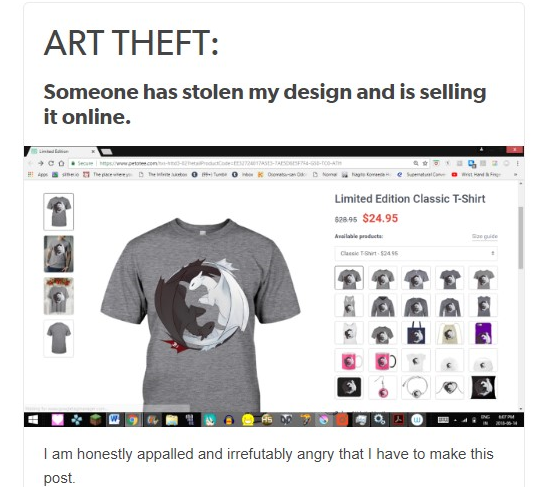
Hundreds of artists have reported that they’ve found sites selling their works on t-shirts, prints, mugs. It’s unbelievable and it’s no longer just work from fandom-based communities, but completely unique works that have been taken and sold with absolutely no permission or even communication with the original creators.

These artists from across Tumblr and Instagram, in some shape or from have had their art stolen and commercially used without permission:

  • double-o-doodles
  • fusspot
  • skylerorionx

Double-o-doodles found their design which they have available on their own Redbubble being sold unauthorized on not only petotee but many other sites and that it had been used for advertisement purposes on Instagram gaining almost 15,000 likes once again without permission or credit. From my knowledge the site they first reported the theft for had the seller and item removed but unfortunately there are still many others selling the design.

Again, Fusspot found their design, having been slightly modified, being sold on amazingtee without their consent.

I wish I could say that this has only occurred through unreliable sellers, but there have been many cases where bigger, well-known stores have stolen designs of an artist and used them for commercial purposes.

Instagram user histrionicoleshop noticed that their design on the right had been replicated by the well known online store, FashionNova, on the left. Their work was originally for sale on their Redbubble account about a year and a half and as recently as three days ago, they noticed it had been ripped off by FashionNova, a store that has been endorsed time and time again by celebrities such as Kylie Jenner and Khole Kardashian. 

Similar case, skylerorionx noticed that target had been selling enamel pins that looked remarkably similar to their own design.

The number goes on and on. These are just some of hundreds, if not thousands of examples of art theft on social media platforms.

As mentioned earlier, social media platforms do have a measure in place to protect users from acts of copyright infringement but if it wasn’t clear enough, these measures don’t appear to be working. It begs the question of whether these platforms should be doing more to stop the spread of art theft. Whether the artist themselves hold sole responsibility to protect their work or accept these actions as a result to uploading their work online.

It also makes me question the minds of the those that steal another’s work in the first place. They’ve been told it’s wrong, clearly know it’s wrong yet they continue to do so. Would stricter measures and punishments even work if those stealing the works already know their actions are wrong?

For an average social media user this may mean nothing, but art theft has a massive impact on an artist, especially those that’s living is supported through their work. When users re-upload art without crediting the source, it doesn’t allow the original artist to receive recognition for their work, something that many spend an undeniably long time creating it.

The best advice that can be given is when you’re faced with work that you know or think has been stolen, ask the the user to credit it’s true ownership and if possible inform the artist of the account using their work. These actions alone, although minor, can offer massive help in fighting online art theft. 

~Until Next Time~

~Collective Intelligence~

By far one of my favorite outcomes of network participation is collective intelligence. The joint collaboration of individuals, one which the emergence of media platforms has blown up, the level of communication and far spread of individuals is insane.

Hall brought forth the notion of “decentralised authority”, that the advancements of our technology now allows “large groups of individuals to connect directly, make decisions, collaborate and share value amongst themselves,” something I find to be quite incredible.

Just take into consideration the platform Reddit where participation of individuals is a key purpose of the site, relying on user based discussion and voting for its content. The users are just everyday people throwing their two cents in with no middleman.

You can imagine how well this works in uncover dirty dets that is often hidden behind centralised platforms. The mass collaboration has the ability to uncover two sides of story, something I find incredible.

~Until Next Time~


~Seeing is believing~

The image above is a remediation of Boston Dynamics SpotMini framed as a Furreal children’s toy, a familiar framing technique to promote sales of children’s toys.

The definition of seeing is believing is that you need to see something before you can accept that it really exists or occurs. But this isn’t always the case.

In fact this old saying is a great way to take a look into human mentality and to see how easy it is to manipulate perception. Simply, the way in which something is framed plays a large part in how in is received.

Take for example Amazon’s Alexa and Google’s Home devices. Both have been framed to appear as necessary home items, promoting convenience with a friendly family system through the use of familiarity.

In reality, these devices are a massive breech in user privacy, collecting mass amounts of data and information thats fed directly back to the data banks of its creators.

Entman stated that “the concept of framing consistently offers a way to describe the power of a communicating text.” Take this in to consideration with had if either company marketed the items without the glitz and glam, you can believe the sales would not be as high as they are. This is the power of framing.

~Until Next Time~

~Who Controls Your Media?~

When was the last time you questioned who was in control of the media outlets you access? From news to social media, are they really as neutral as you assume, they are? Well the answer is no, not really. No source of media run by human individuals can be truly unbiased.

Considering media ownership, I believe is an incredibly important factor in choosing the outlets in which you gather news and information. With the emergence of social media our exposure to any forms of media is amplified and leaves us open to manipulation and having some understanding on why they source you’ve chosen to trust in has published something can help determine its true intentions. Whether if it’s truly for public interest or to be used as a tool of manipulation.

Data & Society ran a research project on the media manipulation. They found that media “can catalyze social change” and “challenge the stability of social institutions”. It should come to no surprise that if the owner of a media outlet had a certain agenda that they’d they stick between the lines of their content.

Much of the media I myself consume is mostly from online social platforms such as twitter, Instagram etc, most of which are run by independent sources. Otherwise I rely upon networks such as Seven and the ABC for official stories and newspapers such as the Daily Telegraph and the Sydney Morning Herald.

I’d like to say the media I surround myself with is a reflection of myself to an extent. Honestly it wasn’t until very recently due to various events and the constant notion of ‘fake news’ that I’ve truly began to question my trust in the media, more so the individual places in which I view and share content. In today’s society and with the shear amount of exposure to the online community I fully intend and recommend questioning the motives of our media sources.

~Until next times~

~New Age Media~

In this day and age digitalisation has broken the barrier between production and consumption. No longer is the consumer a passive member of media, having instead embraced the emergence of digital technologies, they are taking an active role in the production and distribution of content across the web.

In terms of economy, legacy media content is expensive to produce and allows a higher risk of failure compared to emergent media which has low cost of production, virtually free and a low risk of failure.

One such example is the rise of Vaporwave and the new a e s t h e t i c, subcultures that run hand in hand. Vaporwave is a genre of music identifiable by its remediation of 80s-90s mood music vibes whilst the a e s t h e t i c is an art form often exhibiting low quality visuals of retro electronics, Japanese lettering and classic statues all tied together in vibrant colours or clean pastels.

Kevinwong in his web post believes that Vaporwave is a product of “exponential technologies” and that its popularity is due to its lack of cost to create and the abundant range of free programs to do. Thus, making it one of the many forms of media to arise within digital production.

Think back to McLuhan’s ‘the medium is the message”. Would Vaporwave and the a e s t h e t i c art form be just as popular and have such a wide audience if it wasn’t free to create and view? More than likely not.

~Until next time~

~Convergence~

The internet is something that is a part of our daily lives so much so that we don’t even realise just how extraordinary it is and how much it has developed over the last 30 or so years, how media has developed in general. A move from analog to digital media has revolutionised the way in which media is produced, distributed and consumed.

Take a look at the timeline above. How many of these devices do you know? Better yet, which ones have you used? It would appear that many of these technologies have become obsolete as what happens. Technology improves, new devices are created and the old is shoved in a box for the day it can be sold on Ebay for a pretty buck. But have old media types truly been forgotten?

Jenkins considered that “Old media are not being displaced. Rather, their functions and status are shifted by the introduction of new technologies,”. It’s interesting, in a way the internet and other modern media technologies are a reflection and combination of their predecessors. A convergence. Email was once post. We’ve seen (some of us) the rise and fall of record, cassette and disc music, now in which is dominantly streamed or downloaded online. Television has ascended to various online streaming services and so on.

Yes, many of these devices still exist and are still in use today. But looking deeper. Can any of these devices do the job of another? Can any single one of them do as much as the internet can?

~Until next time~

Design a site like this with WordPress.com
Get started